
I’ve walked through enough fire-damaged homes in Suffolk County to know that your first thought isn’t “inspection checklists.” It’s “How do I fix this nightmare?”
Last summer, I got a call from a family in Bayport. Kitchen fire. The husband sounded exhausted on the phone. He told me they’d been sleeping at his sister’s place for two weeks and had no idea where to even start. When I pulled up to the house, there was still fire department tape around the front porch. The smell of wet charcoal hit me before I even opened the door.
That’s not unusual. Most people I talk to after a fire feel stuck. They look at the soot-covered walls, the hole where the roof used to be, the soaked carpeting, and they think, “Who’s going to buy this?” Some folks spend weeks scrubbing walls and patching drywall before they’ll even call someone. Others just avoid the house altogether because it’s too much to deal with.
Here’s what I want you to know: a Long Island cash buyer like us looks at a house completely differently than a regular buyer or a bank appraiser. We’re not showing up expecting granite countertops and fresh paint. We’re not scared of a mess.
In this guide, I’m going to walk you through our actual inspection process, what we look at, what we don’t care about, and how we come up with an offer, so you can stop worrying about selling a fire-damaged house fast and start figuring out your next move.

The “Must-Checks” (What We Actually Look At)
When I walk into a fire-damaged property, I’ve got my work boots on, safety gear ready, and a mental list I’ve been running through for years. I’m not checking paint colors. I’m looking at the bones of the house.
The Structure Comes First
Fire eats the finishes first: drywall, carpet, and trim. That stuff looks scary, but it’s usually cosmetic. What I need to figure out is how deep the damage went.
Framing and Beams
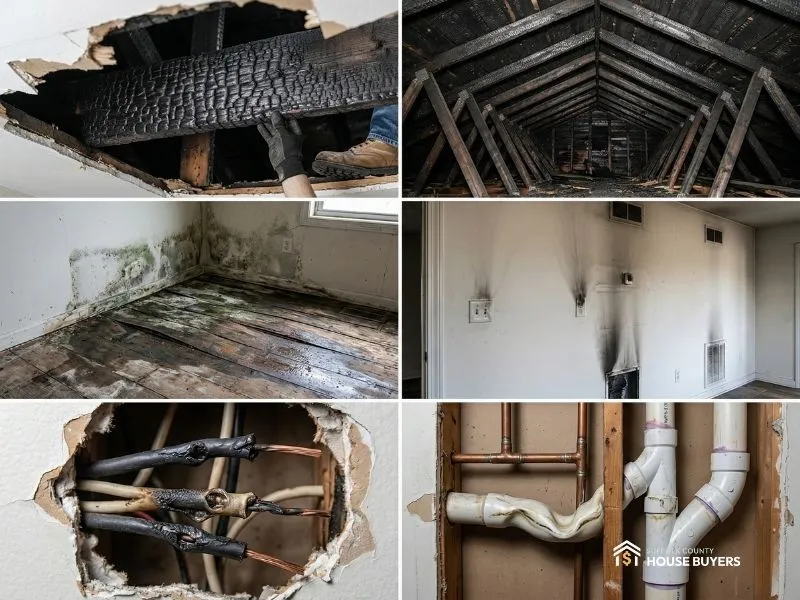
I check the exposed wood framing, and I’m looking for something we call “alligatoring.” That’s when wood chars in a pattern that looks like reptile scales. I’ve seen it hundreds of times. If the scales are large and deep, that wood has lost its strength and needs to go. But light, surface-level scorching? That can usually be sealed and saved. One house I looked at in Centereach last year had a charred kitchen ceiling beam that looked awful, but when I tapped it and checked the depth, it was solid underneath. That’s the kind of thing you can’t tell from a photo.
The Roof
Heat rises. Even if the fire was in the kitchen, the attic might be done. I always get up there and look at the trusses and rafters. Are they charred? Is the roof line starting to sag? Swapping out a few rafters is one budget. Replacing the whole roof structure is a different conversation.
The Damage You Don’t See (Smoke and Water)
Here’s something a lot of people forget: the fire department puts out the fire with thousands of gallons of water. I’ve seen houses where the water did more damage to the structure than the flames did.
Water Damage
If the fire happened a week or two ago and the house has been sitting empty, I’m going straight for the subfloor and the drywall. Wet wood breeds mold fast, and anyone who’s lived through a Long Island summer knows how humid it gets out here. If I push on the subfloor and it feels spongy, I know we’re looking at a full rip-out. That happened at a place in Brentwood, the fire was contained to one room, but the water had been sitting under the hardwood floor for three weeks. The mold was already spreading into the next room.
Smoke
Smoke is sneaky. It travels through electrical outlets, vents, and ductwork. I check whether the smoke damage is on the surface or if it’s gotten into the insulation and HVAC system. A lot of the time, ductwork that’s been filled with smoke can’t be cleaned; it has to come out. That tells me whether we’re looking at a lighter renovation or a “down to the studs” job.
Safety Systems (Electrical and Plumbing)
This is the big one. Safety is non-negotiable for us.
Electrical
We follow guidance that NEMA (the National Electrical Manufacturers Association) has put out on fire-damaged wiring. The bottom line is simple: if wiring or electrical equipment has been exposed to heavy heat, even if flames never touched it directly, the insulation around those wires is probably shot. Heat melts the protective coating on wires even behind walls, and you can’t see it. We generally assume anything near the heat source needs to be pulled and replaced. The last thing anyone wants is for the house to catch fire again after it’s been fixed up.
Plumbing
Copper pipes can take a beating, but PVC drain lines? They melt. I always check the plumbing stack and supply lines for heat distortion. If the pipes look warped or “wavy,” they’re done, and they’ll leak.
What We Ignore (The “Don’t Worry About It” List)
This is the part that catches most homeowners off guard. I can’t tell you how many times someone has apologized for the state of their house before I’ve even walked in. Look, I get it. But to us? This is Tuesday.
The Mess and Debris
Please, for your own sanity, don’t clean up for us.
I don’t care about piles of burnt debris, soaked carpet, or ruined furniture. We have crews that handle all of that after closing. I’ve stepped over mountains of trash and waded through soggy rooms to get to a utility closet. It doesn’t faze me, and it doesn’t change our offer.
Cosmetic Damage
Peeling paint, soot-stained walls, melted siding, I don’t look twice at any of it. Since we’re almost always taking the space down to the studs anyway, it doesn’t matter if the walls are black or white. They’re coming down either way.
Personal Belongings
We buy properties as-is. That means exactly what it sounds like. Grab your valuables and anything sentimental, and leave the rest. You don’t need to rent a dumpster. You don’t need to call a junk removal company. Take what matters to you, and we’ll deal with everything else.
Curb Appeal
Overgrown lawn? Boarded-up windows? Fence falling over? That’s expected when you’re selling fire-damaged property. We’re not going to ask you to “spruce it up” for a showing. There are no showings.
The Math Behind the Offer (How We Actually Come Up With a Number)
I’m an open book on this. There’s no secret formula, no black box. I’ll walk you through the math on a napkin if you want.
How We Calculate It
After-Repair Value (ARV) – Repair Costs – Risk = The Cash Offer.
- ARV: What will the house sell for once we fix everything up and make it look like new?
- Repair Costs: The labor and materials to fix fire damage, water damage, and bring the place up to code.
- Risk: We’re a business, so there’s a profit margin in there. But the risk number is usually bigger than the profit number. Fire houses are full of surprises.
Why Selling As-Is Can Actually Save You Money
I know what you’re thinking: “Shouldn’t I fix it myself and sell it for full price?”
Maybe. But fixing a fire-damaged home is nothing like a kitchen remodel. You need specialized remediation contractors. And if you’ve ever tried to pull a building permit in the Town of Brookhaven or Islip, you know what I’m talking about. It is not a fast process. You’ll need architectural drawings, inspections, and possibly a new Certificate of Occupancy. All that takes months and costs tens of thousands before you even list the place.
When we buy, we take on that headache and that risk. You don’t spend your own money on repairs and cross your fingers hoping to get it back later.
The “Unknowns”
Fire houses hide things. Once we open up a wall, we might find damage that went a lot further than anyone thought. We build a buffer into our rehab budget for exactly this reason, so we don’t have to come back to you two weeks later and try to renegotiate.
When I give you a number, that’s the number. I don’t play games with “inspection contingencies” where I try to nickel-and-dime you after you’ve already committed. That’s not how I do business.
The Hidden Cost of Sitting on a Fire-Damaged House (Taxes and Insurance)
One thing that really gets to me is when I see a homeowner hold onto a fire-damaged property for months, sometimes years, because they can’t figure out what to do. While that house sits there, it’s eating your money.
Suffolk County Taxes Don’t Stop
Even if your house is unlivable, the tax bill keeps showing up. And if you live out here, you already know Suffolk County taxes aren’t cheap.
There’s a form called RP-467-n, which is an Application for Assessment Relief. If your home has been damaged by fire, you can apply to get your assessment lowered, which brings your taxes down. But here’s the catch: it takes time. Paperwork, documentation, and waiting for the town to process it.
Selling a fire-damaged house fast stops that bleeding. You stop paying $10,000+ a year in taxes on a house you can’t even live in.
Insurance Gets Complicated Fast
Check your homeowners’ policy. Most policies have a “vacancy clause.” If the home sits empty for more than 30 or 60 days, your coverage can change, or get dropped entirely.
Getting insurance on a vacant, fire-damaged house is expensive and hard to find. Between the taxes, insurance, and keeping the utilities on so the pipes don’t freeze in January, carrying costs can eat up thousands of dollars of your equity in just a few months.
Our Inspection vs. a Traditional Inspection
If you list your home with a real estate agent, you’ll go through a traditional inspection. Here’s how that stacks up against what we do.
Speed is the Big Difference
Traditional:
The inspector is there for three to four hours. They produce a 50-page report. Every scratched outlet cover, every loose doorknob, every cracked tile, it’s all in there. Then the buyer’s agent uses that report to ask for a $20,000 price reduction. I’ve seen it happen a hundred times.
Us:
Most visits take me 30 to 45 minutes, then I’m gone. There’s no interest in bargaining chips or nitpicking. What I’m watching for are deal-killers: major structural issues that make the house unsafe or unrealistic to save. If the foundation is solid and the house is still standing, we can usually work something out.
No Banks, No Headaches
Banks don’t touch fire-damaged properties. They won’t lend on a home that’s missing a working kitchen or a heating system. That means you literally cannot sell to a regular buyer who needs a mortgage.
As a Long Island cash buyer, we use our own funds. No bank approval needed. Our inspection is for our own planning, to figure out the scope of the renovation, not for some loan officer to sign off on.
How the Process Works (Step by Step)
If you decide this is the route for you, here’s what to expect.
Step 1: Give Us a Call (or Fill Out the Form)
Tell me the address and be straight with me about the fire. “The kitchen is gone,” or “It was just the garage”, either way, it helps me come prepared. No judgment.
Step 2: The Walkthrough
We come out, usually within 24 hours. I’ll do the quick check I talked about above: structure, systems, and scope of work. I’ll be in and out before you know it.
Step 3: The Offer
You get a written number. No pressure. Say yes, say no, or take a few days to think it over and talk to your family. It’s your call.
Step 4: We Handle the Rest
If you accept, we take care of the title work through a local title company that knows how to handle these deals. Still have an open insurance claim? We can even help line things up with your adjuster so the timelines work together.
You’ve Got Options
A house fire is awful. No getting around that. But the sale of the house doesn’t have to be another disaster on top of everything else.
You don’t have to fix a single thing. No rigid bank-style inspection to pass, either. And you can stop stressing about what the neighbors think when they notice boarded-up windows.
If you’re staring at a fire-damaged property right now and you just want to turn the page, let’s have a conversation. No obligation, no sales pitch, just honest answers about what the house is worth and what your options are.
Frequently Asked Questions (FAQs)
Can I sell my house if the fire investigation is still going on?
We can usually come take a look and even put together an offer while the investigation is still pending, as long as it’s safe to go inside. We do typically wait for the fire marshal or your insurance company to officially release the property before we close, though. That way all the legal stuff is covered and nobody’s in a bind.
Do I need to clean out the burned furniture before you come look at it?
No. Please don’t spend your time or money on that. We buy properties with everything in them. You take what you want to keep, and we’ll handle the rest after closing. This is one of the biggest relief points for people we work with; you can just walk away.
Will you buy the house if the roof has caved in?
Yes. When the damage is that bad, we usually look at it as a land-value deal. We’re still interested, but the offer reflects the cost of tearing down what’s there rather than renovating it.
How does selling to a cash buyer affect my insurance payout?
Usually, you’re entitled to the insurance money for the damage that happened (the “loss”), and you can also sell the property for what it’s worth in its current condition. They’re separate things. But every policy is different, so I always tell people to check with their public adjuster or insurance agent to make sure they’re getting the most out of their claim while selling as-is.
How fast can you close on a fire-damaged house?
We move as fast as the title work allows. That’s usually about two to three weeks. If you’ve got a hard deadline, like you need the money to put a deposit on a new place, we can often speed things up.
Do I have to disclose the fire damage if I fixed it cosmetically?
Yes. New York disclosure laws don’t play around. Since March 2024, the old option to pay a $500 credit instead of filling out a Property Condition Disclosure Statement is gone. You have to disclose known problems. Selling to us as-is is often the safest route because we buy with full knowledge of the damage. That protects you down the road if someone ever tries to come back with a lawsuit.
Do you buy houses with water damage from the fire hoses?
Absolutely. We expect water damage in fire situations. Mold remediation is a standard part of how we renovate these homes. It’s baked into our budget from the start.
I’m overwhelmed. Can you help me deal with my insurance company?
We’re not public adjusters, but we’ve been through this process a lot. We can help explain to your adjuster that you’ve got a cash offer on the table, which can sometimes make the claim settlement go smoother. And if you need a recommendation for a good public adjuster on Long Island, I’ve got a few names I trust.